Quick answer
Muscle aching that begins hours after unfamiliar exercise, is strongest around 24–72 hours, and then gradually eases can fit delayed-onset muscle soreness, or DOMS. Timing alone cannot confirm the cause. (pmc.ncbi.nlm.nih.gov)
For mild soreness, ease off demanding exercise and choose comfortable everyday movement or a lighter activity. Do not push through sharp pain. (health.clevelandclinic.org)
Seek medical care immediately for tea- or cola-colored urine, unexpectedly severe muscle pain, or marked weakness after exercise. Call 911 for new chest pain or pressure, or severe unexplained breathlessness. (cdc.gov)
Updated October 4, 2026. This guide provides general fitness education, not a diagnosis or a personalized recovery plan.
1. What typical delayed muscle soreness feels like
DOMS often follows a new activity, a return to exercise, or a session that asks more of your muscles than usual. It commonly causes tenderness, stiffness and aching in the muscles you worked—not necessarily pain during the workout itself. (my.clevelandclinic.org)
The usual pattern is:
- A delay: soreness commonly starts about 12–24 hours after exercise.
- An early peak: discomfort is often strongest 24–72 hours afterward.
- Gradual improvement: it settles over subsequent days, generally within a week. These are typical ranges, not a diagnostic test or a deadline everyone must meet. (pmc.ncbi.nlm.nih.gov)
Unfamiliar eccentric muscle work is a common trigger. “Eccentric” means a muscle is producing force while lengthening—for example, controlling the lowering part of a movement. Large amounts of this work, especially when performed infrequently, can produce soreness and temporarily reduce muscle function. (acsm.org)
That helps explain why unfamiliar squats or a walk containing more downhill sections than usual may leave you aching later. Downhill walking is one recognized example of eccentric exercise. (my.clevelandclinic.org)
Soreness does not provide a simple measurement of muscle damage. Its mechanisms are still being studied; “tiny tears” alone do not explain every case. (pmc.ncbi.nlm.nih.gov)
2. When to stop exercising and seek help
Do not label every symptom after exercise “just DOMS.” Delayed symptoms can also occur with more serious problems. Use the following distinctions to decide what to do—not to diagnose yourself.
Stop the movement
Sudden, sharp, strong or persistent pain during exercise deserves attention. Stop rather than repeatedly testing the painful movement. Seek assessment if sharp pain restricts movement, or pain persists despite rest. (health.clevelandclinic.org)
Get prompt medical assessment
Seek prompt care when you have:
- Severe or worsening pain.
- Substantial or increasing swelling or bruising.
- Difficulty bearing weight, walking more than a few steps, or using the affected area.
- Pain accompanied by fever or chills.
These are reasons for assessment rather than another workout or a home “recovery challenge.” (nhs.uk)
If presumed soreness is not improving with rest, remains sharp and constant, or lasts more than a week, contact a healthcare professional. You do not need to wait a week when symptoms are severe or worrying. (my.clevelandclinic.org)
Recognize urgent warning signs
Rhabdomyolysis, sometimes called “rhabdo,” is a serious condition to consider when muscle pain is much worse than expected, urine becomes tea- or cola-colored, or weakness is unusually pronounced. Symptoms may begin hours or days after muscle injury. Seek medical care immediately; do not wait for all three signs. Symptoms alone cannot confirm or rule it out—clinical testing is needed. (cdc.gov)
New chest pain or pressure and severe unexplained breathlessness are not a muscle-recovery question. Stop exercising and call 911. Do not assume chest discomfort is harmless because you recently trained your upper body. (professional.heart.org)
3. What to do today if soreness is mild
For low-level soreness without warning signs, you may not need complete inactivity. A lighter activity can be reasonable, while more painful soreness or difficulty performing your usual movements is a reason to avoid strenuous exercise. (health.clevelandclinic.org)
Use this practical sequence:
- Check ordinary movement first. Notice how you feel during activities you normally perform, such as walking around your home, dressing or rising from a chair.
- Choose something familiar and easy. This might be a short, level walk, gentle cycling or comfortable seated movement, depending on your usual abilities.
- Keep it genuinely light. Do not turn the session into a hill workout, a fast ride or another demanding strength circuit.
- Stop if symptoms increase. Sharp pain, worsening discomfort or movement that feels unsafe is not something to “work loose.”
- Check again afterward. Record whether symptoms stayed stable, eased or became worse.
These steps are a conservative planning aid, not a validated medical screen. A brief improvement while moving is not proof that you are ready for a hard session.
Research suggests active exercise may reduce DOMS-related pain, but the evidence is low quality and results vary considerably. Think of gentle activity as an optional way to remain comfortably active—not a guaranteed shortcut to recovery. (pubmed.ncbi.nlm.nih.gov)
4. How long to wait before another demanding workout
For beginner strength training, a useful starting rule is to leave one full day between sessions that work the same muscle group. Mayo Clinic also advises stopping an exercise that causes pain and considering a lower resistance or trying again after a few days. (mayoclinic.org)
For example, a Monday leg-strength session could be followed by a Tuesday without demanding leg training. Wednesday is an opportunity to reassess—not an automatic instruction to repeat the workout.
A calendar cannot tell you everything. Recovery speed varies, and intensely exercising sore muscles is different from using them comfortably during daily life. (my.clevelandclinic.org)
Before repeating a demanding session, ask:
- Are ordinary movements back near my usual level?
- Can I perform an easy version without changing my movement to avoid discomfort?
- Is the overall trend improving?
- Am I free of the warning signs described above?
Treat those as planning questions, not clearance tests. If soreness makes the movement difficult, postpone it or choose a different, comfortable activity. If pain makes you unsure whether you are dealing with an injury, seek assessment rather than experimenting with heavier loads.
5. What stretching, massage and recovery tools can—and cannot—do
Recovery advice often mixes two different outcomes: feeling less sore and being ready to perform again. They are not interchangeable.
Stretching is not a proven DOMS fix
A systematic review of randomized trials found no clear reduction in soreness at 24, 48 or 72 hours from post-exercise stretching compared with rest. Confidence in the evidence was very low, and participants were mostly young men. (pubmed.ncbi.nlm.nih.gov)
If gentle stretching feels comfortable, you can choose it for that reason. Do not force a sore muscle into a painful position or assume that a longer stretch will erase soreness.
Massage may modestly reduce discomfort
A systematic review found small improvements in DOMS with sports massage, but no evidence of direct improvements in strength, jumping, sprinting or endurance. Less soreness after massage therefore does not establish readiness for harder exercise. (pubmed.ncbi.nlm.nih.gov)
Massage is optional. You do not need to buy treatment to follow a sensible recovery plan.
Other methods have uncertain benefits
A broader review found possible pain benefits from several approaches, including cold treatments, compression and active exercise. However, the authors rated the evidence low quality, with substantial variation between studies. (pubmed.ncbi.nlm.nih.gov)
For a beginner, the practical priority is adjusting the workload and allowing recovery—not assembling an expensive collection of tools. Do not use any comfort measure as permission to ignore worsening symptoms.
6. Worked example: adjusting after unfamiliar squats
This is an illustrative decision process, not a prescribed routine or a reported result.
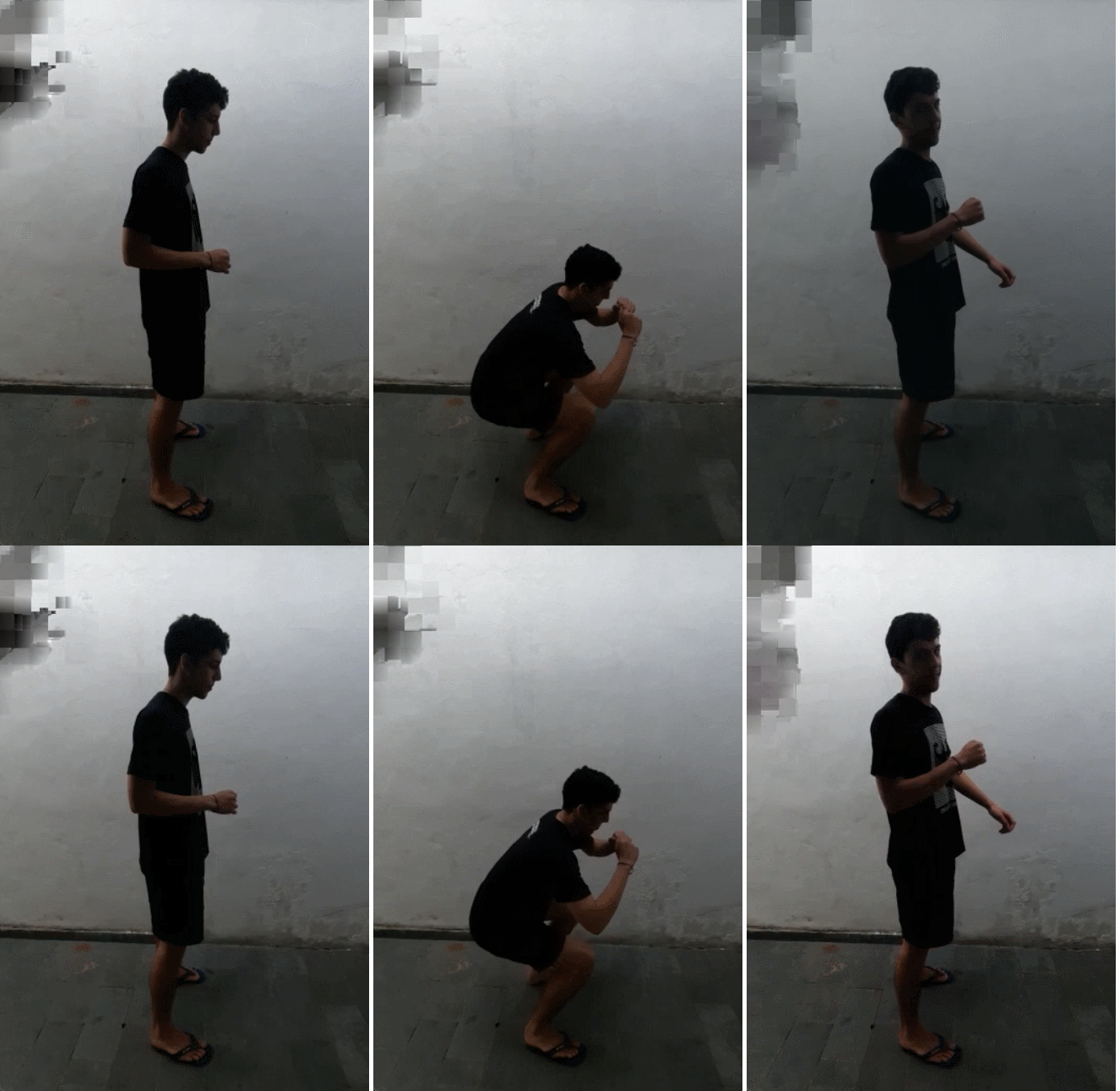
Suppose you return to exercise and do two sets of bodyweight squats on Monday. The session feels manageable. On Tuesday, your thighs ache when you sit down or stand up.
Here is how to use the guidance:
First, check the symptom pattern. Delayed thigh aching after leg exercise could fit DOMS, but sharp pain, substantial swelling, marked weakness or dark urine changes the decision. The warning signs take priority over your workout schedule. (my.clevelandclinic.org)
Next, change Tuesday’s plan. Do not repeat the demanding squat session simply to keep a streak. If ordinary movement is comfortable and no warning signs are present, choose an easy familiar activity. If moving is difficult, skip strenuous exercise. (health.clevelandclinic.org)
Then reassess before the next leg session. Leaving Tuesday free of demanding leg training follows the one-full-day spacing rule, but it does not prove you have recovered. (mayoclinic.org)
Make the repeat session smaller if you are ready. One possible adjustment is one set instead of two, using the same manageable movement. With the same repetitions per set, that halves the planned repetitions. This illustrates reducing the amount of work; it is not evidence that a particular reduction is safe for everyone.
Record what happens next. Note the exercise, amount of work and how daily activities feel afterward. Use that information to plan the following session.
After a longer-than-usual walk, apply the same logic: reassess symptoms, then return to a shorter familiar route rather than immediately repeating the longer distance.

7. Common mistakes and a simple next-workout checklist
Mistake: treating soreness as the goal. A workout can be productive without DOMS. Do not add extra work merely because you were not sore afterward. (my.clevelandclinic.org)
Mistake: changing everything at once. Adding new exercises, more resistance and more total work makes the next session harder to judge. Gradually increasing intensity and volume is a better approach than jumping into large amounts of unfamiliar eccentric work. (acsm.org)
Mistake: trying to “flush out lactic acid.” Lactate does not remain trapped in your muscles for days and explain peak DOMS. (pmc.ncbi.nlm.nih.gov)
Before your next session, write down:
- What you did last time.
- When symptoms started.
- Whether ordinary movement is improving.
- Any warning signs.
- What you will reduce, postpone or keep easy.
If soreness repeatedly disrupts normal activities, discuss it with a healthcare professional. If you have a chronic condition, ask your clinician about suitable activity types and amounts. (health.clevelandclinic.org)
The aim is repeatable activity—not proving that you can tolerate pain.