Quick answer
Start with bodyweight exercises if you want to try strength training before buying anything. Consider resistance bands if compact storage matters and you can follow their setup instructions. Choose dumbbells if you prefer clearly labeled loads and straightforward weight tracking.
All three count as muscle-strengthening activity. You can also combine them rather than commit to one system. Choose equipment around movements you can perform safely—not the biggest set available. (cdc.gov)
1. Choose usable resistance, not a “best” equipment category
Strength training means making your muscles work against resistance. That resistance can come from your own body, an elastic band or an external weight. CDC guidance recommends muscle-strengthening activity on at least two days each week, covering the major muscle groups—not just arms. (cdc.gov)
Bands are not merely a stepping stone to “real” weights. A 2019 systematic review comparing elastic resistance with dumbbells and weight machines found no clear superiority of either method for upper- or lower-body strength gains. The corrected review included eight studies with different participants and training approaches. That supports bands as a legitimate option, not a promise that every band workout equals every dumbbell workout. (pubmed.ncbi.nlm.nih.gov)
Before shopping, answer four questions:
- Where will I exercise? Consider movement space as well as storage.
- Which positions are manageable? Standing, sitting and getting down to the floor are different requirements.
- What can I hold securely? Test the actual handle or band grip when possible.
- How will I increase difficulty? Look beyond the first workout.
Treat these as decision prompts, not a fitness test. The useful purchase is the one that solves a specific problem in your planned routine.
2. Bodyweight: a no-purchase starting point, with adjustment limits
Bodyweight exercise does not have to mean floor push-ups or demanding circuits. NHS beginner guidance includes wall press-ups, sit-to-stands and supported mini-squats—options that do not require getting onto the floor. (nhs.uk)
Why consider it: You can begin without purchasing resistance equipment and find out which movements and exercise times suit you.
What to check: A wall needs to be clear, and any chair used for support must be stable and unable to slide. For chair-based exercises, NHS guidance recommends a solid chair without wheels. (nhs.uk)
Grip demands: You may not need to grasp a weight, but some exercises still place pressure through your hands. Do not assume “no equipment” means a movement will suit uncomfortable wrists or limited hand function.
Progression limits: Your body does not come with a weight-selection dial. Ask whether the next exercise variation is manageable or represents a much larger challenge. NHS guidance advises building repetitions gradually rather than rushing progression. (nhs.uk)
One practical limitation is exercise selection. If your planned bodyweight routine lacks a manageable pulling movement for your back, consider whether a band or dumbbell would fill that gap. Do not improvise a pulling station from an unverified table, door or piece of furniture.
A useful first experiment: Try a wall press-up. Stand at arm’s length, place your hands at chest height, bend your elbows slowly while keeping your back straight, then press back. Stop before control deteriorates. This follows the movement described in NHS beginner guidance. (nhs.uk)
3. Resistance bands: compact equipment that needs a repeatable setup
Bands are worth considering when you want equipment that can be put away between sessions. However, “resistance band” covers different designs. Before buying, check whether the exercises you want require a flat band, a loop, tubing with handles or an anchor.
Adjustability: Elastic resistance depends on how much the material stretches. Changing your hand position or distance from an anchor changes the setup as well as the challenge. A band’s resistance label is therefore not directly interchangeable with a dumbbell’s labeled weight. (tumbltrak.com)
Grip demands: Ask whether you can secure the material or handle without slipping. Manufacturer instructions describe dedicated handles and other attachment accessories; use only compatible accessories and the specified attachment method. (tumbltrak.com)
Storage: Check the product’s care instructions. The TheraBand guide advises keeping bands away from direct sunlight and extreme temperatures. (tumbltrak.com)
Progression limits: Do not assume that moving farther away is always an acceptable way to make an exercise harder. Follow the product’s maximum stretch limit, and select another resistance level when appropriate. Limits and attachment methods must come from your own equipment’s instructions. (tumbltrak.com)
A useful shopping question is: “Can I explain exactly how I will use this band?” If the answer depends on an anchor you do not have, include that accessory and its setup requirements in the decision.
4. Dumbbells: clear load labels, but check the minimum weight
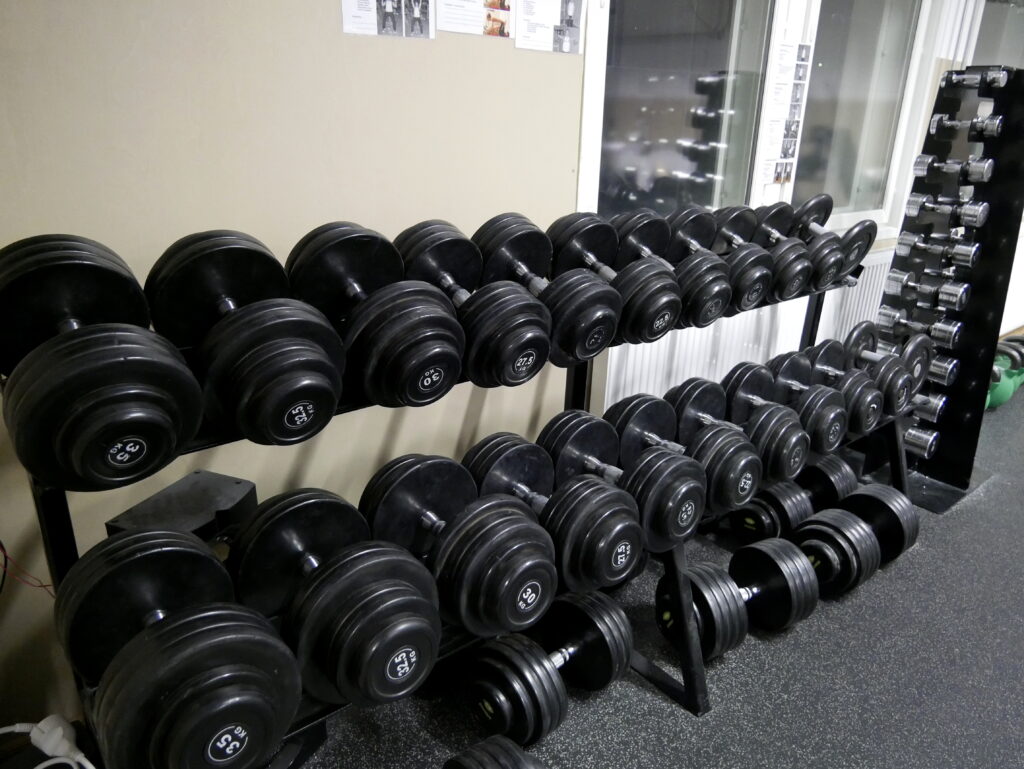
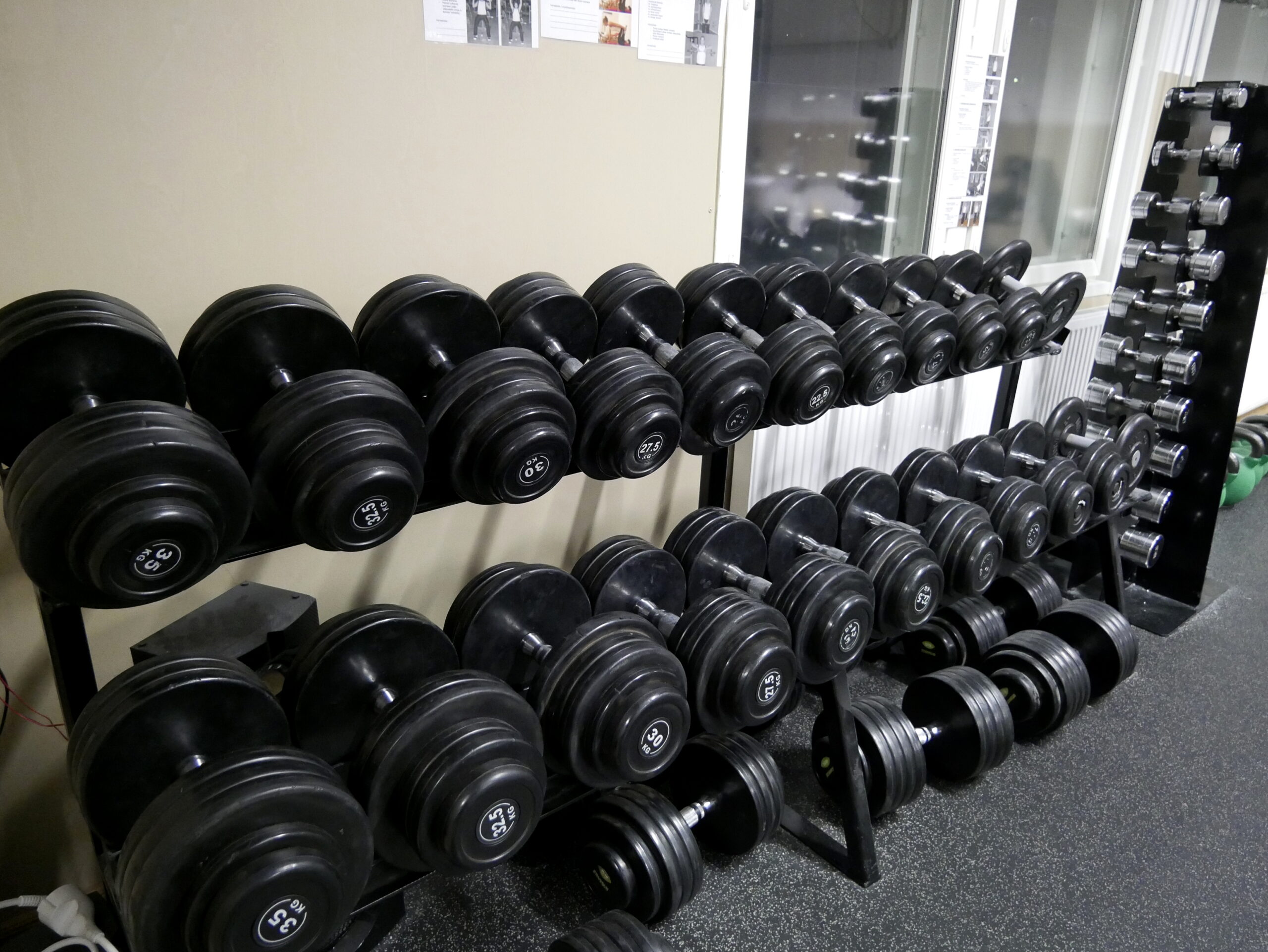
Dumbbells suit readers who want to record a labeled load alongside repetitions. Light hand weights can also be used while seated: NHS guidance explicitly includes seated biceps curls. (nhs.uk)
Compare the purchase options this way:
| Option | What to check before buying |
|---|---|
| Fixed-weight dumbbells | Can you use this particular weight for your intended movements? Where will additional weights go? |
| Adjustable dumbbells | What is the lowest setting, how large are the increases, and how does the securing mechanism work? |
| Either type | Can you grip, retrieve, carry and put them away safely—not just lift them during an exercise? |
Do not judge an adjustable set by its maximum capacity alone. Read the specifications for the lowest available load and the steps between settings. Also examine the instructions for weight selection, inspection and storage.
Mechanical checks matter. For example, the opened Bowflex adjustable-dumbbell manual requires inspection and locking-mechanism tests and warns against dropping the equipment. Those are instructions for that particular design, not a universal procedure for every adjustable dumbbell. Follow your own model’s manual. (download.bowflex.com)
Grip and space check: If possible, hold the equipment before purchasing. Does the handle feel secure? Can you move without the ends contacting your chair or body? Include the base, plates or stand when checking storage space.
A clear weight label is useful, but it does not make an unsuitable load appropriate.

5. Inspect bands and verify anchors before every session
Band safety deserves its own buying decision. If you cannot establish a safe anchor setup, choose an exercise that does not require one or another form of resistance.
Before using a band:
- Inspect it for nicks, tears, punctures or cracks.
- Check connection points and accessories.
- Remove damaged equipment from use.
- Control the return movement; do not release a stretched band and let it snap back. (tumbltrak.com)
For a door anchor:
- Read the instructions for that exact anchor and band.
- Check the door, frame, latch and hinges.
- Use the specified placement and pulling direction. The manufacturer guides reviewed favor pulling so the door is forced closed, rather than pulled open.
- Close and secure the door as directed, and prevent anyone from opening it during exercise.
- Test the setup and perform slow practice movements. Stop if anything shifts. Keep your face out of the possible rebound path. (thestrongband.com)
Do not treat a doorknob or convenient piece of furniture as an approved anchor. A photograph of a setup also cannot verify the strength of the door, attachment or surrounding structure.


6. Three practical equipment choices—and a worked example
These are illustrative decisions, not personalized exercise programs.
Small apartment: Begin with standing bodyweight options that do not require clearing floor space. Consider a band if it adds an exercise you want, but first check the space needed when it is stretched. If a door anchor would obstruct a shared doorway, choose a different setup. Manufacturer guidance requires checking the door and surrounding area before anchoring. (nhs.uk)
Limited budget: Make no purchase initially. Try suitable wall press-ups and sit-to-stands, then identify what is missing. A specific need—such as a manageable pulling exercise—is a better reason to buy equipment than an unusually large accessory bundle. These bodyweight movements appear in NHS beginner guidance. (nhs.uk)
Preference for seated exercise: Consider light dumbbells for movements such as seated curls. Use a stable chair and check that the equipment clears it. NHS seated guidance recommends feet supported on the floor and a solid, non-wheeled chair. If you use a wheelchair or need specialized support, seek advice about your own seating and equipment rather than applying ordinary-chair instructions automatically. (nhs.uk)
Worked example: choosing a first weight for seated curls
Suppose you prefer seated exercise and are deciding whether to buy light fixed weights or an adjustable set.
- Practice bending and lowering your arms without weights.
- If trying a weight, choose one you can hold securely while keeping your upper arms beside your body.
- Curl slowly, then lower slowly. Stop if you need to swing or lean to complete the movement.
- Record the equipment and number of controlled repetitions.
- Compare those needs with the adjustable set’s minimum setting and next increase.
The movement follows NHS seated-curl guidance. The selection process is a practical example, not a validated test or a prescription. There is no single correct starting weight for every beginner. (nhs.uk)
7. Progress by recording what you actually did
A repetition is one complete movement; a set is a group of repetitions. CDC suggests trying 8–12 repetitions per activity and at least one set, with additional sets offering further benefits. Its guidance describes working until another repetition would be difficult. That is not a reason to sacrifice technique or ignore symptoms to reach a number. (cdc.gov)
For your training notes, record:
- Bodyweight: the exercise variation, support used and repetitions.
- Bands: the exact band, attachment, hand position and starting location.
- Dumbbells: the labeled load and repetitions.
For bands, those setup details matter because stretching changes resistance. (tumbltrak.com)
When the current version becomes manageable, consider one change at a time: more repetitions, a suitable resistance increase or another appropriate variation. Gradual repetition increases are part of NHS beginner guidance. (nhs.uk)
Avoid two common mistakes: buying only for your present needs without considering the next step, and choosing resistance increases so large that you cannot control them.
8. Run this checklist before spending money
Before checkout, write down:
- The exercises this purchase will enable.
- The easiest usable setting or variation.
- The next manageable progression.
- Any required anchor or accessory.
- The space needed during use and storage.
- How you will inspect and maintain it.
- Whether you can retrieve and put it away safely.
If any answer is unclear, pause the purchase and check the instructions. No single equipment category is required: bodyweight, bands and weights all appear in CDC’s examples of muscle-strengthening activity. (cdc.gov)
Breathe continuously and use controlled movements. Do not push through sharp pain. Stop for chest pain, faintness or unusual severe breathlessness, and seek urgent help for severe or persistent symptoms. If you have a chronic condition, are recovering from injury or are unsure about suitability, ask a qualified clinician. This article is general education, not individualized clearance; see the site’s Disclaimer.