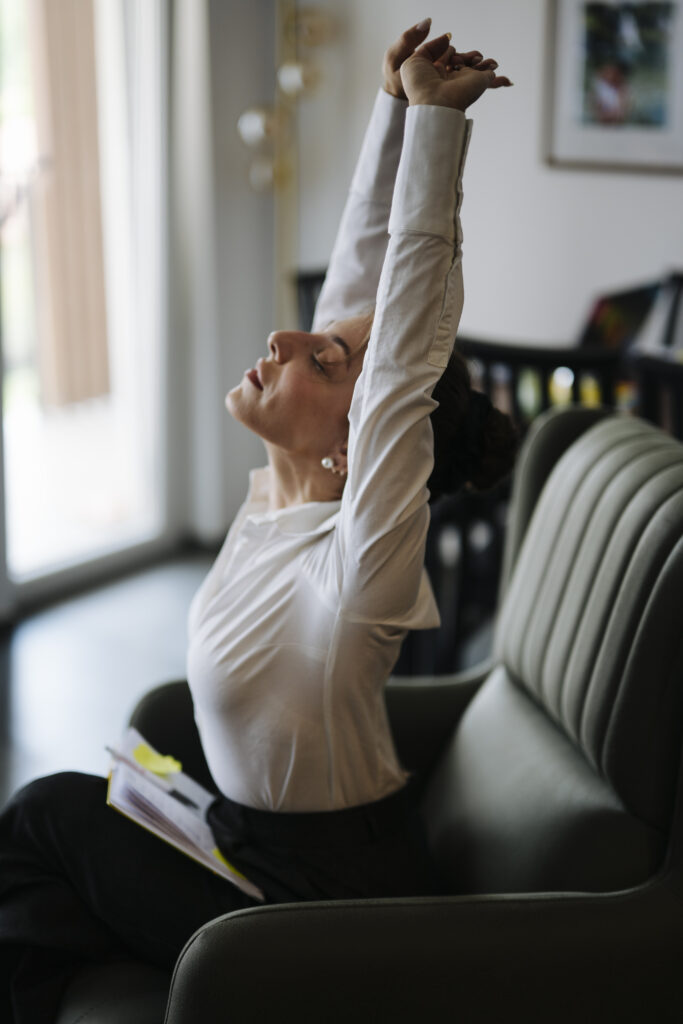
Quick answer: Flexibility concerns the range of movement your tissues allow; mobility emphasizes moving through that range with active control. Beginners can practice both: use gentle, controlled movements around a warm-up, and do comfortable held stretches after exercise or after warming up separately. Aim for useful movement—not the deepest possible stretch. (acefitness.org)
1. Mobility and flexibility describe different parts of movement
Range of motion means how far a joint moves in a particular direction. Bending your knee and lifting your arm overhead involve different ranges of motion.
In fitness practice, flexibility usually describes the range available, influenced by how readily muscles and other connective tissues allow movement. Mobility emphasizes your ability to actively reach and control that range. Strength, coordination and balance can therefore matter alongside flexibility. (acefitness.org)
For example, slowly raising your arm and lowering it without leaning backward is active movement practice. Holding a comfortable position that creates a gentle stretch is static stretching. These methods overlap, but their immediate purposes differ: one rehearses movement; the other spends time in a stretching position. (acefitness.org)
The words are not used identically everywhere. NHS exercise guidance, for instance, describes some moving exercises as flexibility exercises. Do not worry about assigning every movement a perfect label. Ask instead: Am I practicing controlled movement, or holding a stretch? (nhs.uk)
2. What stretching research does—and does not—show
Stretching can increase range of motion. A systematic review and meta-analysis published in the March 2024 issue of the Journal of Sport and Health Science examined 77 studies in healthy participants. Repeated stretching programs improved joint range of motion compared with control groups. Static stretching produced larger long-term improvements than the dynamic or ballistic stretching methods studied. That does not establish one ideal routine for every beginner. (pmc.ncbi.nlm.nih.gov)
Timing matters when performance is the goal. A 2016 systematic review in healthy, active people found that longer static stretching—at least 60 seconds accumulated per muscle group—was associated with larger immediate performance reductions than shorter stretching. Most studies tested performance soon afterward, often without subsequent dynamic activity. Those conditions are not the same as taking a comfortable neighborhood walk. (pubmed.ncbi.nlm.nih.gov)
The practical takeaway is not “static stretching is bad.” Use moving practice to prepare for movement, and place longer flexibility work elsewhere if your next task requires substantial strength, speed or power.
The same review found no clear effect of static stretching on all-cause or overuse injuries. This article’s routines should not be treated as proven injury-prevention programs. (pubmed.ncbi.nlm.nih.gov)
3. Where gentle practice fits around exercise
A warm-up is more than holding a few stretches. The American Heart Association recommends gradually warming up for about 5–10 minutes, using the planned activity at a slower pace. For a walk, that can simply mean walking easily before increasing your pace. (heart.org)
A useful order is:
- Before exercise: start easily, then add a few controlled movements if helpful.
- During strength training: rehearse the exercise with an easier version or lighter load rather than forcing a deeper position.
- After exercise: slow down gradually; then add comfortable static stretches if you want to work on flexibility.
- On a separate day: warm up with light activity before held stretches. (heart.org)
Stretching is not a compulsory entry test for walking. Mayo Clinic advises warming up before stretching and suggests that after a workout can be a convenient time because your muscles are already warm. (mayoclinic.org)
Choose practice that relates to your activity. Before walking, ankle and hip movements are more relevant than trying to achieve a deep floor stretch. Before an upper-body exercise, gentle reaching may be more relevant. This is a practical way to organize a session, not a validated universal formula. (acefitness.org)
4. An illustrative pre-walk movement sequence
This optional sequence is a starting example, not a prescription. Use a clear space and keep sturdy support within reach. For seated movements, choose a solid chair without wheels, with your feet able to rest on the floor. (nhs.uk)
First, begin walking at an easy pace. Then pause somewhere stable to try the movements below, or do the seated options before setting out. Continue starting the walk gently rather than treating these few repetitions as a complete warm-up. (heart.org)
-
Controlled knee lifts: five per side. Hold a countertop or other secure support. Lift one bent knee only as high as feels comfortable, lower it slowly, and alternate. Avoid leaning backward or chasing height.
Seated option: sit upright, hold the chair’s sides if useful, and alternate small knee lifts. (patientinfolibrary.royalmarsden.nhs.uk) -
Seated ankle movements: five per foot. Support yourself on the chair and straighten one leg as comfortably as you can with the foot off the floor. Slowly point the toes away, then draw them toward you. Lower the foot and change sides. Keep the movement gentle rather than snapping between positions. (nhs.uk)
-
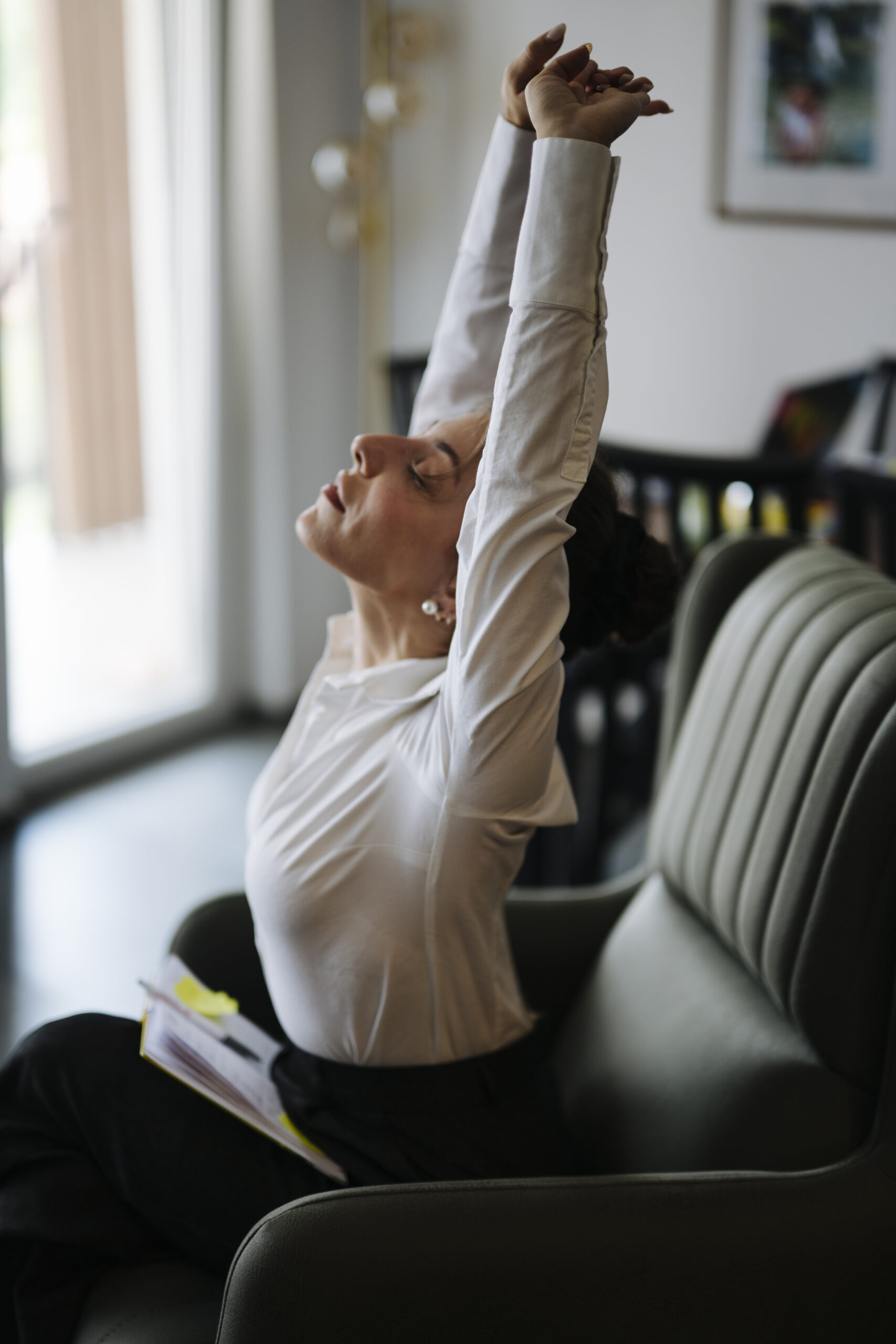
Comfortable arm raises: five repetitions. Seated, start with your arms beside you. Raise them outward and upward only as far as comfortable, then lower them with control. Keep your shoulders relaxed; breathe out while raising and in while lowering. Overhead height is optional. (oxfordhealth.nhs.uk)
Skip a movement that feels awkward or painful. The repetition counts are illustrative; they are not a minimum you must complete.

5. Comfortable post-session stretches, including seated options
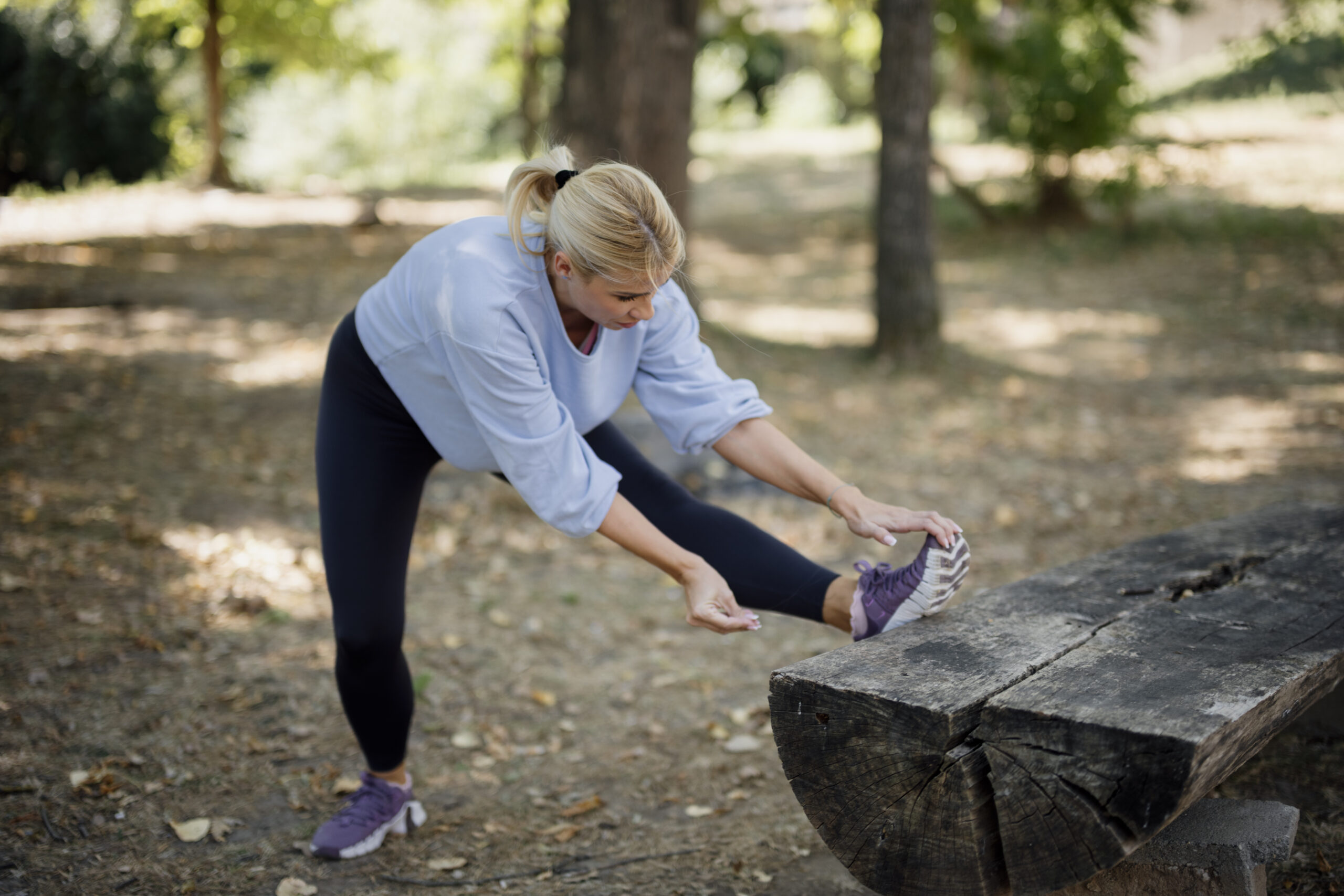
After slowing down from your activity, choose one or two stretches rather than rushing through a long list. General guidance commonly uses roughly 30-second holds, while NHS examples also use shorter holds. There is no need to force yourself to remain in an uncomfortable position until a timer finishes. (mayoclinic.org)
Supported calf stretch
Face a wall and place your hands against it. Step one foot behind you, keep that heel down, and bend the front knee slightly. Keep both feet facing forward and the back leg comfortably straight. Adjust your stance until you feel a gentle pull in the back calf. Hold for about 15–20 seconds, then change sides. Avoid lifting the back heel to lean farther forward. (nhs.uk)
Seated alternative: repeat the controlled ankle movement from section 4. It practices ankle movement rather than reproducing exactly the same calf stretch. There is no requirement to match the standing version’s sensation. (nhs.uk)
Seated back-of-thigh stretch
Sit securely toward the front of a stable chair. Keep one foot planted and extend the other leg in front of you. Sit tall, then tip your upper body slightly forward until you notice a mild stretch behind the extended thigh. Keep the movement small and do not strain to reach your toes. Hold comfortably, return upright, and change legs. (patientinfolibrary.royalmarsden.nhs.uk)
Seated chest stretch
Sit upright and move your shoulders gently back and down. Open your arms to the sides and lift your chest slightly until you feel a mild stretch across its front. Hold for 5–10 seconds, then release. Keep the movement small if opening your arms farther is uncomfortable. (nhs.uk)
For every stretch, breathe normally, stay still rather than bouncing, and back off if tension becomes pain. (mayoclinic.org)

6. A worked example for a manageable walking habit
Suppose you already find a 15-minute walk manageable and want to add gentle movement practice. You could organize it like this:
- Minutes 0–5: walk easily.
- Brief pause: try the section 4 movements, using a chair for the seated options.
- Remaining walking time: continue at a comfortable pace, easing off toward the end.
- Afterward: choose one lower-body stretch and, if comfortable, the seated chest stretch.
This is an illustrative schedule built around gradual preparation and optional post-session stretching—not a tested program or a promise of results. Shorten the walk, omit movements or use only seated practice when that better fits your starting point. (heart.org)
For consistency, a practical starting plan is to attach the same small selection to two weekly walks. Public guidance recommends regular flexibility practice, but research does not establish one perfect beginner dose. (nhs.uk)
Record what you did and whether it felt comfortable. When it becomes familiar, change one element at a time: add a few controlled repetitions or a little comfortable range, rather than increasing everything together.
7. Common mistakes and practical safety checks
Trying to win the stretch. More range is not automatically the right goal. Before each repetition, ask whether you can move into and out of the position slowly without losing control. If not, use a smaller movement. (acefitness.org)
Bouncing or holding your breath. Keep held stretches steady and breathe normally. A stronger pulling sensation is not a reason to push harder. (mayoclinic.org)
Using stretching instead of a gradual warm-up. Start the activity easily. Do not jump straight from a held stretch into your fastest walking pace or a demanding lifting set. (heart.org)
Using unstable support. Check that a chair cannot roll or tip and that the surrounding floor is clear. Choose seated practice when standing balance makes the movement difficult. (nhs.uk)
Ignoring a health limitation. If you have an injury, medical condition or uncertainty about a movement’s suitability, ask a qualified clinician or physical therapist about adaptations. A generic routine cannot assess the cause of restricted movement. (nhs.uk)
Stop a movement that causes pain rather than trying to stretch through it. The goal is a repeatable habit you can perform comfortably—not a particular pose, depth or comparison with someone else. (mayoclinic.org)
For the limits of general fitness guidance, see fitnessportal.org’s Disclaimer.